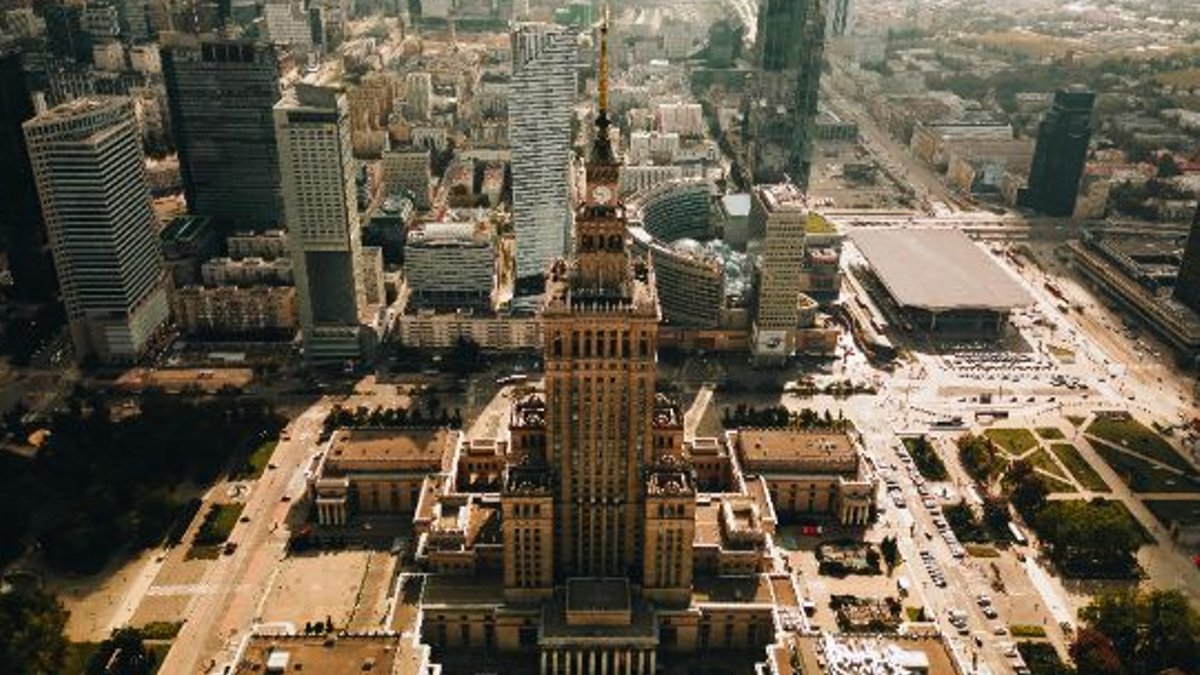
Warsaw has climbed to third place among Europe’s most attractive cities for commercial real estate investment, trailing only London and Madrid. The ranking confirms a shift in perception: investors now view the Polish capital as a core European market with strong liquidity, transparency, and risk-adjusted returns.
Economic tailwinds and demographic strength
The city’s rise stems from Poland’s position as the fastest-growing major economy in Europe. Oxford Economics forecasts Warsaw will lead European GDP growth in 2026, fueled by expansion in IT and business services. Unemployment in the city remains at 1.6%, while the national rate sits at 5.6%, supporting consumer confidence and demand for commercial space.
Inflation has settled near the central bank’s target at 2.4%. The National Bank of Poland reduced interest rates by 175 basis points in 2025, with additional cuts expected through 2026. These moves have improved financing conditions, unlocking development and investment across asset classes. Per-capita purchasing power in Warsaw now exceeds the European average, marking its transition toward a knowledge-based economy.
The metropolitan area’s population of 3.1 million continues to grow, driven by internal migration and an expanding international workforce attracted to technology and shared services sectors.
Infrastructure as a catalyst
Warsaw’s location at the intersection of major European transport corridors provides a key advantage. Chopin Airport, the busiest in Central and Eastern Europe, offers direct flights to over 120 global destinations, while Modlin Airport serves low-cost carriers. Rail connections link the city to Berlin, Vienna, Prague, and the Baltic states, reinforcing its regional hub status.
The most significant near-term project is the extension of Metro Line M2 to Bemowo, scheduled for completion in late 2026. Historical patterns suggest the extension will lift property values by 10–20% in surrounding areas, creating opportunities for early investors. Longer-term, the Central Transport Hub will integrate air, rail, and road networks, strengthening Poland’s role as a continental logistics center upon completion.
Road infrastructure upgrades are also underway, with new expressway sections reducing travel times to key logistics corridors. These improvements solidify Warsaw’s position as a distribution hub for Central and Eastern Europe, reflected in its dominant share of Poland’s industrial and logistics stock.
The office market’s supply crunch
Warsaw’s office market faces one of Europe’s most pronounced supply-demand imbalances. Total modern stock reached 6.23 million square meters at the end of 2025, but new supply has contracted sharply. Only 90,000 square meters were delivered during the year—a 15% decline from 2024—while space under construction fell by 16% to 190,000 square meters, signaling further constraints through 2026–2027.
Related: SERHANT Says Growth Is Not a Business Plan
Demand remains strong. Total take-up hit 790,000 square meters in 2025, up 7% year-on-year, with the fourth quarter setting a record at 310,000 square meters of signed leases. Renewals accounted for 51% of activity, while new leases, expansions, and owner-occupied deals made up the rest. The vacancy rate dropped to 9.1% by year-end, down 1.5 percentage points from 2024, with stark differences between central and non-central locations: 6.1% in the City Centre versus 11.6% in peripheral areas.
Prime rents in the central business district ranged from €24.00 to €28.00 per square meter per month in December 2025. Top-tier properties commanded above €27.00, with select locations exceeding €30.00. Tenants prioritize certifications like WELL, LEED, and BREEAM, along with smart building technologies and flexible workspace solutions. Older buildings in districts like Służewiec are being converted to residential use or upgraded, improving the overall quality of available space.
Multinational corporations continue expanding their presence. AstraZeneca renewed and expanded its lease to 22,500 square meters at Postępu 14. Polkomtel followed with a 22,700-square-meter renewal at Multimedia House of Plus. These deals highlight Warsaw’s growing role as a regional headquarters for pharmaceuticals, technology, and financial services.
Industrial and logistics: a maturing sector
Poland’s industrial and logistics market ranks fifth in Europe, with total modern stock reaching 36.6 million square meters at the end of 2025. The Warsaw metropolitan area leads with 7.34 million square meters, cementing its status as the primary logistics gateway for the region.
The sector is shifting toward quality-focused development. New supply in 2025 fell to 1.68 million square meters, while gross take-up reached 6.64 million square meters—the third-highest annual result in market history. Demand came from third-party logistics operators, retail chains, and light manufacturing, which made up about 15% of leasing volume. The national vacancy rate stood at 7.4% at year-end, down 0.8 percentage points from the previous quarter, with Warsaw and other prime hubs showing tight conditions.
A key trend for 2026 is competition for land and resources between logistics and data center developers. Warsaw’s inclusion in the FLAP-D markets—Frankfurt, London, Amsterdam, Paris, and Dublin—combined with its logistics infrastructure, places it at the center of this rivalry. Automation and technology integration are transforming the sector, driving demand for facilities with enhanced power capacity and ceiling heights. This has created a divided market where modern, sustainable assets command premiums over older stock.
Asking rents have stabilized, with big-box facilities at €3.80–5.00 per square meter per month and city logistics schemes at €5.00–7.50. Forward funding models and sale-and-leaseback transactions are gaining traction, reflecting confidence in long-term fundamentals. Investors are increasingly active in similar high-growth markets.
Retail, tourism, and the living sector
Warsaw’s retail sector is adapting to broader European trends. The market benefits from strong purchasing power growth, with about 30 new international brands entering Poland in 2024. Retail parks dominate new supply, while shopping center owners refresh concepts and tenant mixes to stay competitive.
Experiential retail is gaining ground. Landlords are integrating entertainment, fitness, and food and beverage elements to drive sales and foot traffic. High street retail in central Warsaw benefits from tourism, where foreign visitors account for 22–25% of turnover in central areas, providing stability against domestic economic shifts.
Related: Housing market finally stabilizes report says
The hotel market is thriving. In 2024, the city welcomed 12.2 million visitors, a 10% increase from the previous year, with over 8 million overnight stays. The first half of 2025 saw 18.9 million tourists in Poland, an 11.6% year-on-year rise. Hotel occupancy reached about 70% nationally, with revenue per available room in Warsaw surpassing pre-pandemic levels. The capital hosts 15 of Poland’s 16 luxury hotels, reinforcing its leadership in the segment. About one-third of foreign guests visit for business, reflecting its role as a corporate hub.
The residential market is seeing rapid institutional growth. The Private Rented Sector has expanded with nearly 24,700 units added over the past five years, making up 87% of total institutional stock. In 2025 alone, 5,821 units were introduced, with another 6,200 expected in 2026. Vacancy rates in the sector stand at 3.5%, with average occupancy hitting 98% after initial lease-up, attracting significant capital. The market is diversifying into co-living and purpose-built student accommodation, with a record 3,800 beds delivered in 2025.
Investment activity and outlook
Poland’s commercial real estate investment market reached €3.98 billion in total transaction value in 2025. The fourth quarter confirmed sustained investor interest despite macroeconomic and geopolitical challenges. Domestic capital accounted for almost 20% of transaction volume—a record, signaling local buyers’ growing confidence in the market.
The industrial and logistics sector recorded the second-largest transaction volume at €1.5 billion, an 11% year-on-year increase. Warsaw’s yield advantage remains strong: prime office yields sit at about 6.00%, offering a significant spread over Western European markets. As interest rates normalize and core capital from Western Europe and the U.S. returns, the city is positioned to attract substantial reallocation.
Several factors make Warsaw a top-tier European investment opportunity for 2026. Supply constraints across office, industrial, and residential sectors are driving rental growth and yield compression. The office market’s supply gap is particularly acute, with limited new deliveries expected through 2027. The city’s talent pool, concentrated around universities and technology hubs, produces a skilled, multilingual workforce at competitive costs, fueling demand for flexible, high-quality office space.
Infrastructure projects like the metro extension and Central Transport Hub are improving accessibility and unlocking new development zones, especially in western Warsaw. Compared to Western European capitals, the city offers lower entry prices, higher yields, and stronger growth potential—a compelling combination for institutional investors.
Key risks include exposure to geopolitical tensions related to the conflict in Ukraine, though this has not yet hindered growth. Regulatory changes, including the upcoming spatial planning reform effective June 2026, may affect development timelines and costs in peripheral districts. The reform aims to professionalize processes and improve land-use efficiency over time, but its immediate impact remains uncertain.
Warsaw’s transition from a regional leader to a core European gateway is now firmly established. For investors seeking a dynamic, liquid market with strong fundamentals and upside, the city offers the scale and sophistication of larger Western European capitals—with better yields and entry pricing.




Leave a Reply