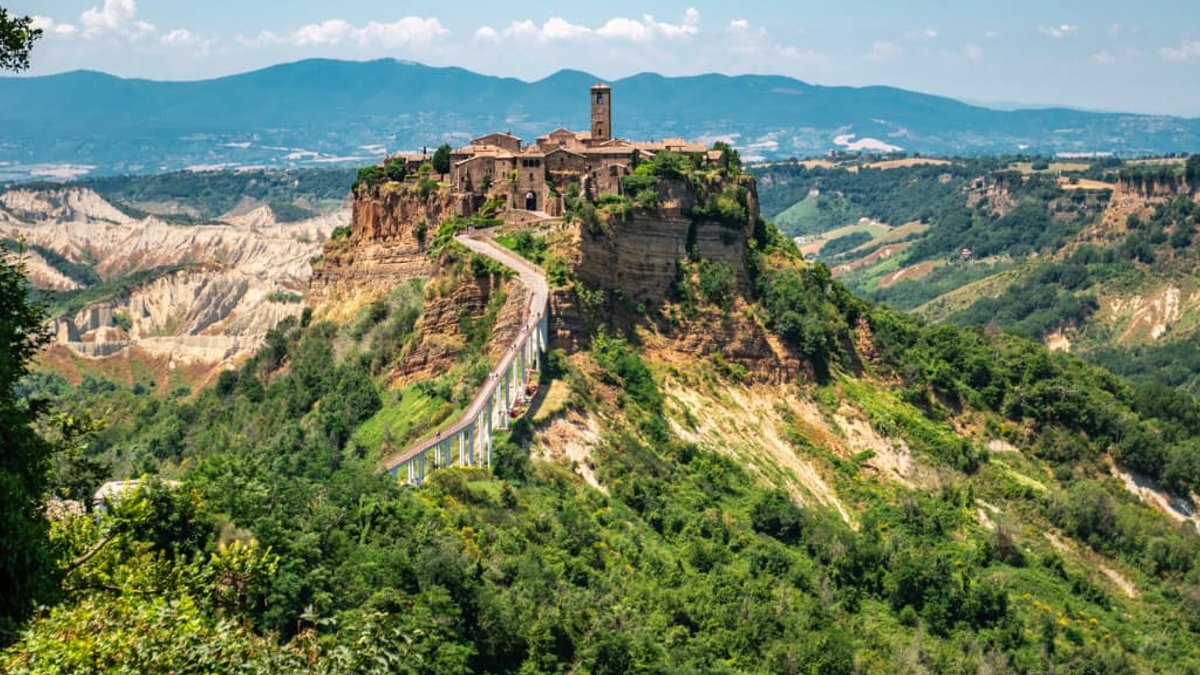
Civita di Bagnoregio, known as la città che muore—“the dying city”—is a village with fewer than a dozen permanent residents that has become a magnet for international buyers, including one of the world’s most famous pop stars. Perched precariously on a volcanic plateau of unstable tuff stone, the settlement is accessible only by a narrow footbridge spanning the Valle dei Calanchi, a dramatic ravine carved by erosion over millennia. The village’s isolation and the relentless geological forces reshaping its foundation have paradoxically transformed it into a symbol of exclusivity, drawing wealthy buyers who adopt its duality: a crumbling relic of the past and a meticulously preserved haven for the present. Unlike other historic Italian villages, Civita’s survival depends not on tourism infrastructure but on its scarcity—both in property availability and the sheer effort required to maintain its existence.
The settlement in Lazio traces its origins to the Etruscan period, dating back more than 2,500 years, though its architectural identity was forged in the medieval era when it served as a fortified stronghold. The Porta Santa Maria, a grand archway carved directly into the tuff rock, marks the sole entrance to the village, a threshold that separates the modern world from a time capsule of stone and memory. Linda Balboni, general manager at Italian Real Estate Lawyers, describes the transition as disorienting: “The moment you walk off that bridge, the noise of the outside world fades into silence. The air smells of dry stone and wild herbs, and the only sounds are the wind through the alleys and the distant murmur of the valley below.” The village’s survival hinges on this juxtaposition—its decay is not a flaw but a defining feature, one that attracts buyers who prioritize authenticity over preservation.
Among its high-profile owners is Harry Styles, who reportedly acquired a vacation home on a 300-by-500-foot outcrop overlooking the valley. His purchase reflects a broader trend: the village has become a status symbol for figures who seek privacy and a direct connection to history.
The property market here operates under the principle of scarcity as luxury. Only six homes are currently listed for sale within Civita itself, a number that has remained stubbornly low for decades, with additional options available just across the bridge in neighboring Bagnoregio. The village’s real estate market is dominated by rustic stone houses with exposed volcanic tuff walls, some dating to the 13th and 14th centuries, alongside more grandeur Renaissance palazzi that have been subdivided into apartments. These buildings often feature timber-beamed ceilings, terracotta floors, and hidden grottos—some repurposed as wine cellars, others as private chapels—while terraces offer panoramic views of the Valle dei Calanchi, a labyrinth of eroded badlands that shifts seasonally with rainfall. Pricing reflects this uniqueness: Italy Sotheby’s estimates that exceptional properties sell for between €158 and €186 per square foot (roughly $180 to $212), a range that accounts for the labor-intensive restoration required to balance historic integrity with modern livability.
Conservation rules are strict, prohibiting structural alterations that could compromise the buildings’ stability. Even minor updates—such as installing new plumbing or electrical systems—must be approved by local authorities, ensuring that any modernization adheres to the village’s aesthetic. Danilo Romolini, sales manager at Romolini Immobiliare, notes that buyers often seek homes where original features like arched doorways, frescoed ceilings, and hidden passageways remain intact, even as they incorporate contemporary comforts. The logistical challenges of living in Civita further heighten its allure: all furniture, appliances, and building materials must be transported across the footbridge, a process that requires careful timing to avoid overloading the structure. Some buyers commission custom-made, lightweight fixtures that can be carried by hand or mule, a detail that adds to the village’s mystique. The volcanic tuff stone, prized for its honey-colored warmth, is also its Achilles’ heel—it absorbs moisture and requires constant maintenance, including repointing mortar and reinforcing foundations. Balboni warns that buyers must budget for ongoing upkeep, as the stone’s porosity demands frequent treatments to prevent erosion.
The village’s year-round population of around a dozen swells in warmer months with second-home owners, many from the U.S. and Europe, who are drawn to its slow pace and unspoiled surroundings. These buyers skew toward entrepreneurs, retirees, and creatives—figures who can afford the lifestyle but seek respite from urban pressures. Some rent out properties as vacation rentals, though the primary motivation remains lifestyle over financial return, a shift accelerated by the rise of remote work and digital nomadism. The absence of commercial development—no chain hotels, no mass tourism—means that Civita retains its medieval-scale intimacy. Evenings in the village offer a stark contrast to daytime tourist crowds: older residents gather outside their homes to play cards, share meals, or discuss local news, a tradition that has endured for centuries. Balboni describes these moments as a living archive of rural Italian life, one that younger generations of buyers are increasingly eager to preserve.
For families considering a move, Civita presents practical challenges that deter many. The nearest English-speaking school, the Viterbo International School, is 45 minutes away, while Rome—with its broader educational options—lies 90 minutes south. Childcare and healthcare require similar commutes, though some expatriate families rely on private tutors or online education to mitigate the distance. The village’s lack of modern conveniences—no supermarkets, no ATMs, no pharmacies—is both a selling point and a limitation. Residents must cross the bridge to Bagnoregio for essentials, though moped permits allow limited access during off-peak hours, easing the burden of transporting groceries or medical supplies. The Valle dei Calanchi and surrounding countryside, however, offer ample compensation: hiking trails wind through eroded cliffs, while thermal spas in nearby towns provide relaxation. Lake Bolsena, a 30-minute drive away, is a hub for water sports, swimming, and sailing, and the region’s vineyards—particularly those producing Est! Est!! Est!!! di Montefiascone, a local white wine—draw oenophiles seeking terroir-driven flavors. Gastronomy is another draw: trattorias in Bagnoregio serve handmade pasta with local truffles, and agricultural cooperatives offer fresh produce, olive oil, and pecorino cheese.
Buyers here prioritize authenticity over luxury, a philosophy echoed by Lodovico Pignatti Morano, managing partner at Italy Sotheby’s. “They’re not looking for a five-star resort,” he explains. “They want a place where history is tangible—where the walls have seen centuries of life, where the air still carries the scent of old stone.” The village’s limited infrastructure—few restaurants, no nightlife, no shopping—only reinforces its exclusivity. Even the two small grocery shops within Civita are run by residents who double as bakers and butchers, selling artisanal bread, cured meats, and seasonal vegetables in quantities that reflect the village’s tiny population. The lack of modern amenities is not a drawback but a deliberate choice, one that aligns with the values of buyers who reject the trappings of contemporary life.
With no new supply entering the market, Pignatti Morano anticipates that prices for exceptional properties will remain stable with gradual long-term appreciation, driven by the fixed demand from international buyers and the ongoing erosion of the plateau, which makes each remaining property uniquely precarious. Geologists warn that the volcanic tuff beneath Civita is eroding at a rate of about 10 centimeters per year, a process that has already claimed entire sections of the village over the past century. Some homes now stand on reinforced foundations, while others have been partially abandoned as the land shifts beneath them. The village’s fate hinges on a delicate balance: preservation to maintain its historic charm versus adaptation to ensure its survival. While buyers adopt the village’s fragility as part of its allure, the long-term viability of Civita depends on whether its residents and new owners can reconcile its past with an uncertain future. For now, the paradox endures—a village on the brink of disappearance remains one of Italy’s most sought-after retreats.




Leave a Reply