Ancient Greek design has never left contemporary interiors, and this summer, Christopher Nolan’s “The Odyssey” gave it a fresh audience, turning Homer’s story into the biggest opening of the director’s career. From klismos chairs to eye-catching marble, designers are looking to Greece to embolden their spaces.
Like the epic poem, Greece’s use of marble has been influential for millennia, from sculpture to architecture. Both Odysseus and marble undergo profound changes during their respective journeys. Spiros Soulis, an Athens-born marble expert, said the material carries cultural meaning to its destinations.
“From the moment it leaves the mountain, often crossing the same seas, extraction, selection, cutting, shaping and human hands transform it. A raw block becomes an architectural element made for a specific place,” Soulis said. “When it arrives, it is different in form, but not in essence. It still carries its mountain, origin, history and every hand that shaped it.”
Greek Influence in Design
Greek influence in design is evident in the work of four designers who worked at very different scales. They did not treat Greek influence as a costume to put on a room. Done right, the results feel less like a movie set and more like the natural environments that have been portrayed on screen.
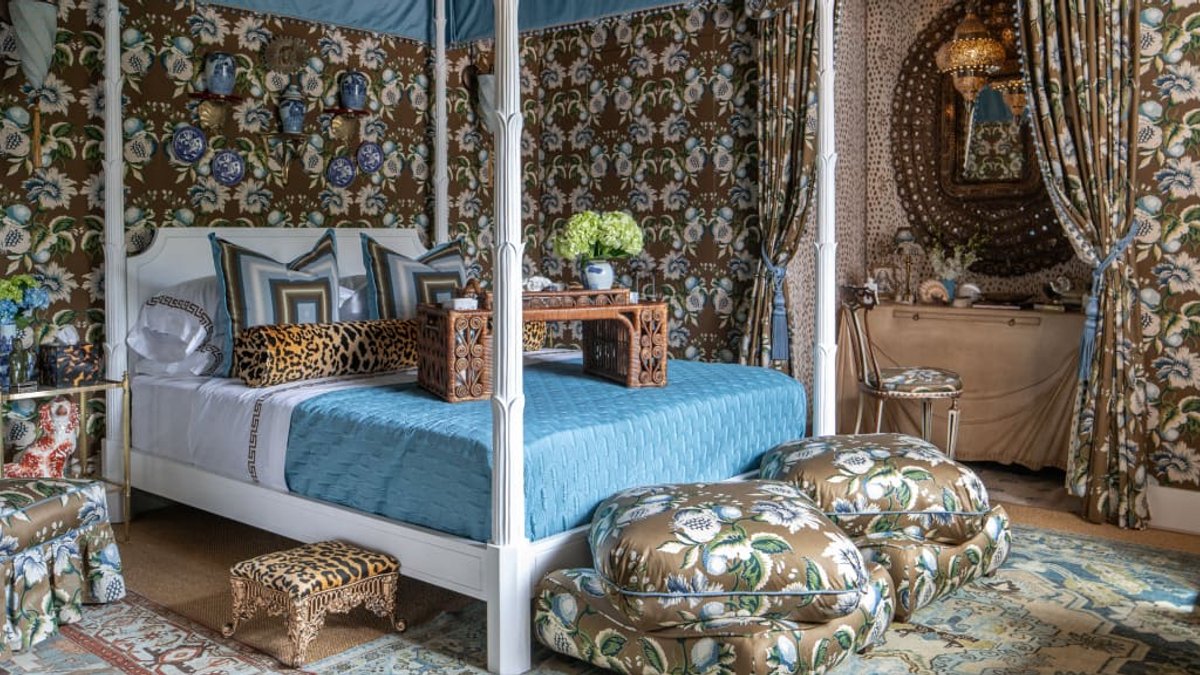
Danielle Balanis, of Danielle Balanis Design, said, “When you take it too literally, it feels like a costume. It has to be very blended, and you have to bring in other elements to tone it down, because it could come off very strong otherwise.”
Balanis added, “I love Greek key trim. It could go on the skirt of a chair; it could go on a pillow; it could go on drapery [or] it could be applied to a lampshade.”
Paolo Ferrari, of Studio Paolo Ferrari, one of the design firms behind Elounda Hills, Crete, Greece, said, “There is something powerful in simplicity and of the earth quality where the materiality itself is the most important aspect, whether it’s a softly shaped solid wood chair or a carved stone object that feels weighty and monumental.”
Ferrari emphasized the importance of natural materials, saying, “One of the simplest things is to introduce natural, mineral materials; stone, limewash, plaster, timber, linen, wool and ceramics, and allow their textures to remain visible.”
Timeless Design Elements
In comparison to other design influences, Greek design stands out for its timeless and effortless quality, which is reminiscent of other classic styles that have withstood the test of time, such as Art Nouveau architecture.
Candace Padavick, of Italkraft, said, “With columns, people like to make them disappear; they keep them white or put mirrors on them, and make them disappear, when, actually that’s a disadvantage to the design, because there are so many beautiful things you can do.”
Padavick suggested adding accent lighting or finishing columns with a contrasting color to make them stand out. She also noted that columns are a nice architectural detail that grounds the space and incorporates natural materials.
Understanding Marble
Spiros Soulis said, “I wish that people knew that marble is not one uniform material. It may be calcitic, dolomitic, calcitic–dolomitic, siliceous or calc-silicate, as well as serpentinous or ophicalcite.”
Soulis emphasized the importance of understanding the stone and its origin, saying, “Each has its own composition, structure and behavior. Some are suitable for exteriors, wet environments or demanding surfaces; others work better in protected interiors.”
In Athens, Soulis said, “Every day when we look up, we look at the Acropolis and the Parthenon. It’s always there to remind us of the glory of the past and the present. It’s also an extremely heavy weight on our shoulders, but it is a continuation of tradition.”
Designers like Ghislaine Viñas are pushing the boundaries of what can be done with marble.





Leave a Reply