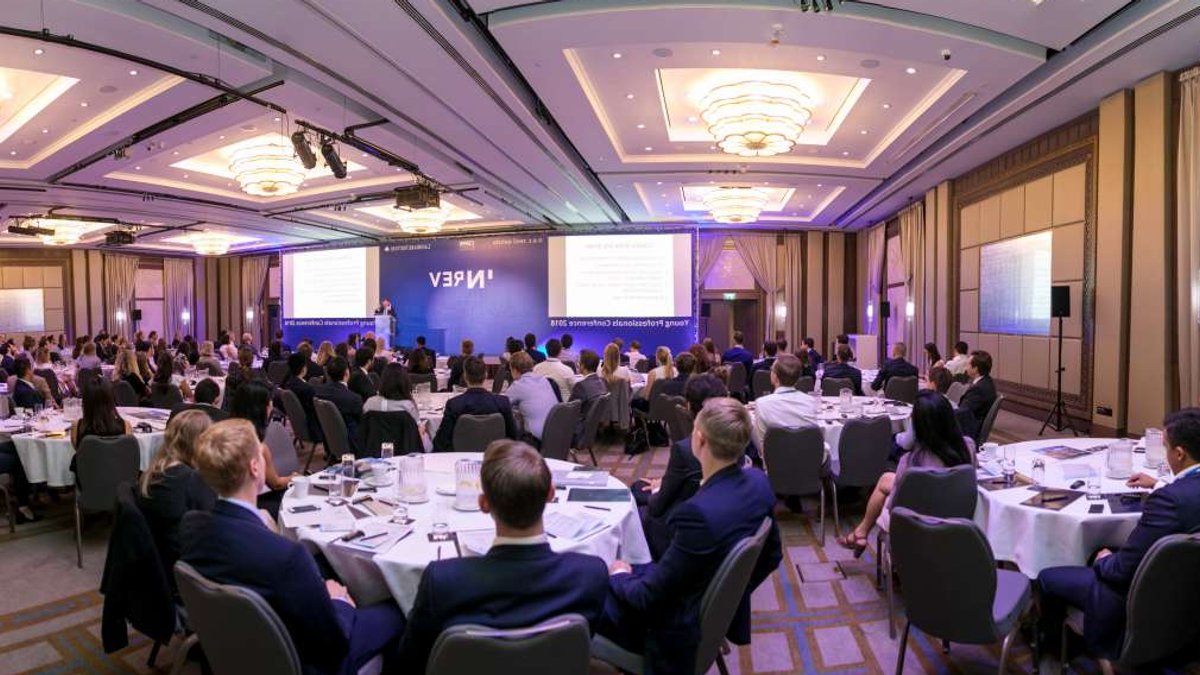
The Young Professionals Conference in Budapest brought together experts to discuss the future of real estate and urban development. The event featured presentations from industry leaders, covering topics from economic trends to technological innovation. The session opened with two key facts: 90% of our lives are spent in buildings and 1/3 of humanity’s resource consumption is caused by real estate, showing the industry’s profound impact on daily life and the environment.
Economic Outlook and Policy Recommendations
Philip Coggan, Bartleby columnist at The Economist, opened the conference with a keynote speech. He began on an optimistic note, predicting England’s advancement in the World Cup, before shifting to a gloomier outlook for the European economy. Coggan highlighted forward-leading indicators suggesting slowing momentum in Europe, exacerbated by the threat of a global trade war, the rise of populism, and immigration challenges. He noted that these issues are likely to alter Europe’s growth trajectory, emphasizing the need for proactive measures.
To address these issues, Coggan proposed several policy recommendations. He emphasized that immigration could alleviate the burden of an ageing population, while labour market reforms, though unpopular, would enhance productivity. He also stressed the importance of investing in education. Despite these challenges, Coggan’s best guess is that Europe will “muddle through” with occasional unpleasant moments. He cautioned, however, that the region’s ability to handle these challenges will depend on its willingness to implement bold reforms.
Real Estate Cycles and Innovation
Brian Klinksiek, Director of European Investment Research at Heitman, discussed the current real estate cycle and its comparison to past cycles. He argued that while this cycle shares similarities with previous ones, such as bull market conditions and record-high peaks, it also differs in key aspects. Notably, market leverage is moderate, supply is constrained, and interest rates are at historic lows. However, trade war dangers are dampening investor sentiment. Klinksiek also highlighted the influence of structural and secular changes on the property market, urging investors to recognize these shifts.
Gustaf Lilliehöök of NREP and Jill Xiaozhou Ju of The Collective highlighted the need for innovation in real estate. Lilliehöök argued that the traditional “buy cheap, sell dear” investment mentality is outdated. Instead, the focus should shift to creating better products that meet customer needs. He provided examples of NREP’s initiatives in logistics, residential, student housing, retail, and sustainability. Ju discussed the rise of co-living spaces, driven by trends like high living costs and an increase in single-person households. The Collective uses a member-driven approach to design spaces that support community and address urban residents’ needs, leveraging anonymous data to enhance shared living experiences.
Related Post: Miami’s luxury market shifts toward experience-driven real estate investments
Ann Marie Aguilar, Director of Operations for Europe at the WELL Building Institute, emphasized the importance of prioritizing health and wellbeing in real estate. She noted that in the modern service economy, health impacts are less visible but no less significant. The institute focuses on ten key factors, including air quality, nourishment, and community, which collectively influence work performance and productivity. Aguilar highlighted the tangible returns of incorporating health and wellbeing, such as improved tenant relationships and productivity, enabled by advancements in technology and data measurement.
Dan Hughes, CEO of LIQUID Real Estate Innovation, explored how technology is reshaping the industry. He identified four key themes: the increased focus on occupiers, the blurring of sector boundaries, the acceleration of processes, and the enhanced understanding of asset value. Hughes concluded by urging attendees to consider how technology is transforming the tasks within jobs rather than the jobs themselves, emphasizing the need to adapt to both direct and indirect changes brought by innovation.
Hans de Jonge provided a broader perspective on the future of cities, arguing that individual buildings derive their value from the urban context in which they exist. He highlighted the importance of wealth inequality, demography, technological advancements, mobility, and the size of current building stock in shaping urban development. De Jonge encouraged attendees to think beyond data and focus on the bigger picture of their role in creating communities, likening city planning to a blend of creative optimization and necessary rules.
Property Tours and Budapest’s Regeneration
Conference delegates toured two significant sites in Budapest. The first was a Beaux Arts building at Liberty Square, designed by Ignác Alpár in 1905 as the Budapest Stock Exchange. This 50,000 m2 palace, centrally located in Budapest’s financial and government district, will be redeveloped into first-class retail and office space, blending historical grandeur with modern functionality.
The second tour showcased Central Europe’s largest regeneration project, a 22-hectare district transforming a once rough neighborhood into a desirable location. The development includes shopping, entertainment, leisure, sport, and dining facilities, exemplifying urban renewal and community revitalization.




Leave a Reply